Roof Insurance Claim Assistance in Murfreesboro, TN
Storm damage is stressful enough. We document your roof, work with your adjuster, and handle the repair so you’re not navigating your insurer alone.
Roof Insurance Claim Assistance in Murfreesboro, TN
Hail, high winds, and severe storms roll through Middle Tennessee every year, and when they do, the roof usually takes the hit first. Most Murfreesboro homeowners are left managing two problems at once: physical damage they can see and an insurance process they’ve never had to navigate. Roof Troops handles the roof side of that equation, from the first inspection through the final repair. We get on the roof, photograph every finding, walk the adjuster through what we found, and complete the work once the claim is settled. If the damage supports a claim, we say so; if it doesn’t, we tell you that too, and you decide what to do next.
We’re a veteran owned company. Showing up on time, doing the job right, and being straight with you about what’s going on are not marketing lines for us. They’re how we were trained.
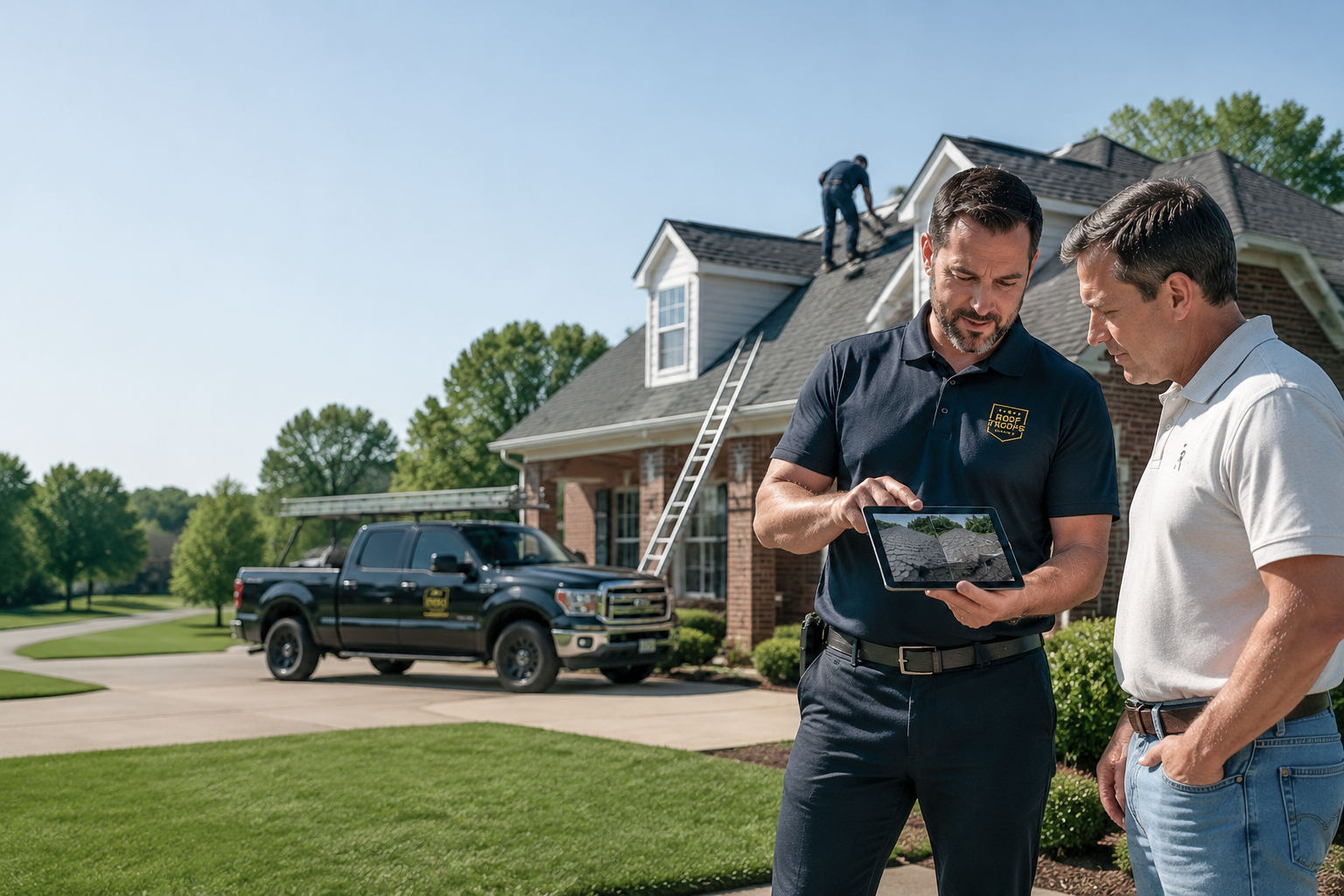
Storm damage is stressful enough. We document your roof, work with your adjuster, and handle the repair so you’re not navigating your insurer alone.
What We Do on Every Insurance Job
Every claim is different, but the work we do on behalf of Murfreesboro homeowners follows the same thorough sequence. Here is what is included from the first call to the finished roof.
Free Inspection After Storm Damage
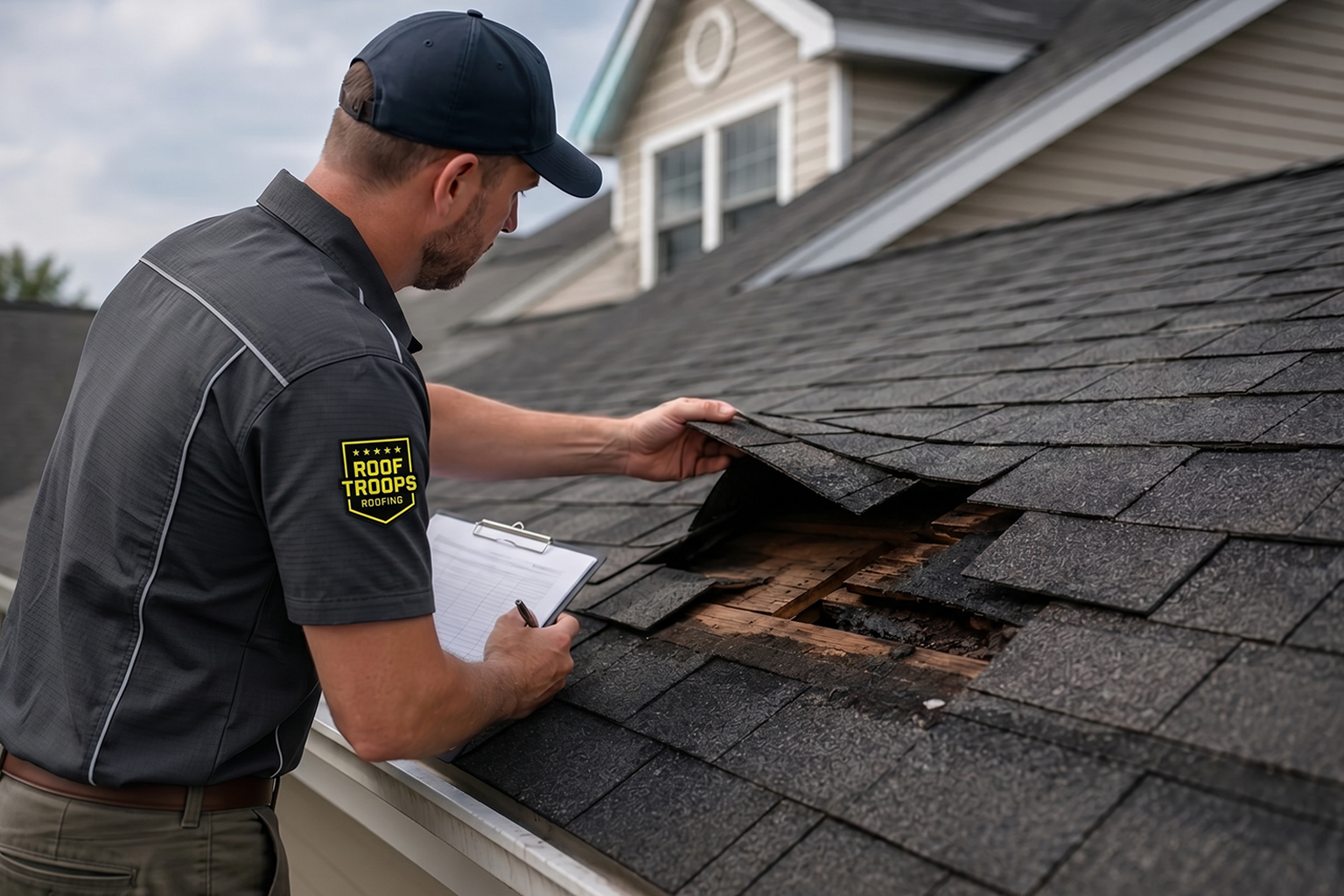
We get on the roof and examine every surface: shingles, ridge cap, flashing, gutters, and all penetrations like vents and pipe boots. This is a real inspection from above, not a quick look from the driveway, because most hail damage is invisible from the ground.
Detailed Photo Documentation of Damage
Every finding is photographed and organized into a record you can share with your insurer. Having your own documentation before the adjuster visits protects you from a rushed visual that misses impact points on multiple slopes.
On-site Walkthrough With Your Adjuster
When your insurance company sends an adjuster, we are there on the roof with them. Adjusters work dozens of claims at a time; a knowledgeable contractor present during the walkthrough ensures the documented damage gets a thorough review, not a fast pass.
Review Of The Adjuster's Report
Once the adjuster's scope and payout come in, we compare them against our own findings line by line. If the scope is accurate, we write the repair estimate to match it; if damage was missed or undervalued, we walk you through what was left out and what your options are.
Licensed Repair Or Full Replacement
After the claim is approved, we do the work with our own crew, under Tennessee contractor license [number], with manufacturer certification from GAF, Tamko, and CertainTeed. Your written estimate is your final invoice, and we call you before the scope changes for any reason.
Storm Damage Warning Signs on Your Roof
Most hail and wind damage is not visible from the ground, which means homeowners in Murfreesboro often have a valid claim without knowing it. These five warning signs, on the roof or inside the house, are reason enough to call us for a free inspection before you contact your insurer.
- Dented or cracked shingle surfaces: Hail impacts leave circular bruise marks or cracked granule surfaces on asphalt shingles, often most visible on south- and west-facing slopes that take the brunt of storm direction. Left unaddressed, those impact points accelerate water infiltration and shorten the roof’s serviceable life by years.
- Granule loss in your gutters: After a hailstorm, granules knocked from shingles wash into the gutters and collect in the downspout elbows, appearing as dark, sand-like material. Granule loss exposes the asphalt mat underneath to UV and moisture, which degrades the shingle faster than any other weathering factor.
- Missing or damaged ridge cap: Ridge cap shingles sit at the peak of the roof and are among the first to show wind damage because they take force from both sides. If ridge caps are cracked, displaced, or missing, the ridge board underneath is exposed to water intrusion every time it rains.
- Flashing lifted around roof penetrations: Metal flashing seals the joints around chimneys, skylights, vent pipes, and valleys, and high winds can pull it loose or crack the sealant that holds it against the roof deck. A gap of even a quarter inch at a flashing joint is enough to send water into the attic with every heavy rain.
- Water stains on interior ceilings: Brown or yellow stains on ceilings or upper walls after a storm usually mean water has already moved past the roof deck and into the structure. By the time a stain is visible from inside, the insulation and decking above it are often already wet.

Contact us after the storm
Call us or request an inspection online as soon as the storm passes. Hail bruising on shingles weathers and fades over weeks; catching it early produces clearer photographic evidence and gives you a stronger foundation before the claim opens.

Thorough inspection and photo record
One of our crew gets on the roof and covers every slope, the ridge line, all four sides of every penetration, and the gutters. You receive a copy of the full photo documentation, organized by location on the roof, so you know exactly what was found and where.

Honest read on your claim
Before we call your insurer, we tell you what we found and what we think it means for a storm-damage claim. If the damage is impact-related and claimable, we say so specifically; if it looks like age or normal wear rather than a storm event, we tell you that too, because filing a claim that doesn't hold up can affect your premium history.

Adjuster walkthrough with our crew
We meet your insurance adjuster at the property and walk the roof with them. Our role is to point to the documented damage and make sure nothing is skipped during what is often a fast-moving, multi-property inspection schedule.

Repair completed to insurance scope.
Once the claim is settled, we complete the repair or replacement to the approved scope, fully permitted, and with a written estimate that matches the final invoice.
How a Roof Insurance Claim Works with Us
What Affects Your Out-of-Pocket Cost
When a legitimate storm-damage claim is approved, most homeowners pay their deductible and little else. But several policy and project variables affect the final math, and understanding them before you file saves surprises later.
Your policy deductible amount owed: Your deductible is the fixed amount you pay regardless of what the claim covers, and it comes out of the insurer’s payout before you see a check. Review your current deductible before filing; for smaller repairs, the repair cost may be close enough to the deductible that a claim isn’t worth the rate impact.
Replacement value versus actual cash: Replacement cost value (RCV) policies pay the full cost to restore damaged materials with equivalent new ones, while actual cash value (ACV) policies subtract depreciation for the roof’s age and condition. On a fifteen-year-old roof, the difference between an RCV and ACV payout can be thousands of dollars, so knowing which policy you hold before filing matters.
Recoverable depreciation held by insurer: Many RCV policies pay out in two stages: an initial check at ACV levels, then a second “recoverable depreciation” payment released after the work is complete and documented. This means you may need to front some of the repair cost initially before the full settlement arrives.
Scope gaps in the assessment: If an adjuster’s report misses damaged areas or undervalues part of the repair, a gap can open between what the insurer pays and what the actual work costs. We review the adjuster’s scope against our own findings before we start, so any gaps are identified while you still have options.
Age and condition of roof: Insurers use the roof’s age and pre-storm condition to calculate depreciation and, in some cases, to determine coverage limits. A roof near the end of its rated lifespan may receive a reduced payout or be subject to additional exclusions depending on the policy terms.
A lot of contractors appear after a hailstorm and disappear when the claim gets complicated. Roof Troops is based here in Murfreesboro, and we do insurance claim work the same way we do everything else: straight documentation, straight answers, and the same written price at the start and the end of the job.
- Locally owned, locally accountable contractor: Roof Troops is owned and operated by Don Hane, who lives in Middle Tennessee to be near family, not to chase storm seasons from state to state. When we finish your roof, we are still in the same area and still reachable if anything comes up.
- Veteran-owned, built on military discipline: Don served two tours in the U.S. Navy, including Desert Storm, and the standard he brought home runs straight through how this company operates: show up when you said you would, do the job right, and never walk away from a commitment. That accountability shows up on insurance jobs, where the temptation to cut corners on scope is real.
- Accurate documentation, no inflated scopes: We document what is on the roof, accurately, and we tell you what we think it means for a claim. We do not add damage that isn’t there, and we do not minimize damage to get past a difficult adjuster; your insurer has fraud investigators, and an inflated claim can void your coverage entirely.
- Licensed, insured, and certified installer: Roof Troops holds a Tennessee contractor license #84570, is fully insured, and is manufacturer-certified by GAF, Tamko, and CertainTeed. Your insurer will require documentation of contractor credentials before releasing payment; we have it in order.
- Discount for all first responders: Veterans, active duty, reservists, National Guard, police, fire, and EMS receive 10% off the work we do. If you have served or you serve now, that discount applies to your repair or replacement, and we mean it as more than a marketing line.
Why Murfreesboro Homeowners Choose Roof Troops
What Murfreesboro Homeowners Say
EXCELLENTTrustindex verifies that the original source of the review is Google. The service performed by these guys is top of the line. From the beginning to end it was never a hassle to figure out what my roof needed. Very satisfied and highly recommended these guys💪🏻Posted on GoogleTrustindex verifies that the original source of the review is Google. Great service, overall experience was fast and very helpful.Posted on GoogleTrustindex verifies that the original source of the review is Google. They did a very very good job! Would use again!Posted on GoogleTrustindex verifies that the original source of the review is Google. Our new roof looks fantastic and we’re sleeping better knowing it’s built to handle Tennessee’s wild weather. If you’re in Murfreesboro, Smyrna, La Vergne, or anywhere in Rutherford County and need reliable roof repair, storm damage restoration, full roof replacement, or gutter installation, Roof Troops Roofing is hands-down the best local choice. Professional, veteran-led, and truly customer-first—thank you for an outstanding job! Highly recommend to anyone searching for top-rated roofing contractors in Murfreesboro TNPosted on GoogleTrustindex verifies that the original source of the review is Google. Roof Troops Roofing completely saved our home after that nasty ice storm rolled through Murfreesboro last month! As a veteran-owned roofing company right here in Middle Tennessee, they earned every bit of our trust from day one. We noticed some leaks and granule loss on our aging roof, so I called them for their free roof inspection—they showed up the very next morning, no pushy sales tactics, just honest advice from Don and the team. They documented all the storm damage thoroughly, explained our insurance options clearly, and even helped file the claim and deal with the adjuster so we didn’t have to fight for coverage. The full roof replacement went smoothly: new premium GAF architectural shingles, upgraded underlayment, proper ventilation, and they added seamless gutters while they were up there to prevent future issues. The crew arrived on time, worked efficiently (finished in 2 days), kept the property super clean—no nails or debris left behind—and communicated constantly so we always knew what was happening.Posted on GoogleTrustindex verifies that the original source of the review is Google. We were extremely pleased from the start with Don and team from Roof Troops Roofing. Communication is very important to us, and he replied to our initial online inquiry the same day, came to evaluate our gutter damage from an ice storm the next day and work was completed within a week. Team was on time and courteous of our property, and price couldn't be beat. We will happily use them in the future.Posted on GoogleTrustindex verifies that the original source of the review is Google. Roof Troops Roofing did a great job with our roof repair. From the first meeting they explained the problem clearly and walked us through the repair process. The crew was professional, showed up on time, and made sure everything was fixed the right way. They were also very careful with our property and cleaned up after the job. Overall a great experience and I would definitely recommend them.Posted on GoogleTrustindex verifies that the original source of the review is Google. The guys at Roof Troops were amazing from start to finish. I was impressed with their proposal and the information that they taught me during our initial meeting. We wanted upgraded shingles with a specific design, and they were able to accommodate our needs. They really took care of our landscaping and architecture, which we really appreciate. We will be informing our neighbors about all of our fantastic experiences with Roof Troops RoofingPosted on GoogleTrustindex verifies that the original source of the review is Google. Roof Troops Roofing really came through when we needed somebody. We were turned down by our insurance company for damages that we received during the storm. We were going to just give up but we tried one more company and Don really showed his skills with negotiating with our adjuster. They bought our whole roof and Roof Troops Roofing did a wonderful job replacing it. We will be recommending them to everyone!Posted on GoogleTrustindex verifies that the original source of the review is Google. We had Don stop out to inspect our roof for damages after the storm. He was the second company we called. He explained thoroughly the entire process which really made us feel at ease because nothing was a surprise. They had to meet our insurance adjuster twice, but finally agreed to pay for the roof. We even got to pick a new color, which was nice. We will be calling Roof Troops Roofing first next time1
Roof Insurance Claim Questions, Answered
Should I call you or my insurer first?
Call us first, or at the same time you notify your insurer that you’ve had a storm event. Getting an independent inspection before the adjuster visit means you have your own photo documentation of the damage, taken while the evidence is fresh. Adjusters typically schedule multiple properties in a day and cannot always spend the time a thorough inspection requires. Having a contractor on the roof with them, with existing documentation in hand, protects you from a quick visual that misses damage on secondary slopes or around penetrations. The inspection costs you nothing, and it gives you a factual baseline before the claim process starts.
Will filing a claim raise my insurance rates?
It can, depending on your insurer, your claim history, and the size of the payout. Tennessee insurers are generally permitted to adjust rates after a paid claim, though first-time claims and weather-related claims are often treated differently than at-fault claims. Before you file, it is worth calling your insurer’s customer line and asking directly how a storm-damage claim would affect your premium, without formally opening a claim. We can help you understand what is on your roof before you make that call, so you can weigh the cost of self-paying a smaller repair against the potential rate impact of filing. That is a decision only you can make, and we will give you the honest information you need to make it.
What if the adjuster's scope differs from yours?
We compare the adjuster’s written report against our own inspection findings line by line and walk you through any differences in plain terms. If the adjuster missed a slope or undervalued a damaged section, you have several options: request a re-inspection through your insurer, provide the supplemental photo documentation we prepared, or bring in a licensed public adjuster who works on your behalf rather than the insurer’s. We are not insurance adjusters and cannot negotiate your claim directly, but we can tell you precisely what was found on your roof and whether the approved scope covers it. That information is yours to use however you decide.
What storm damage does homeowner's insurance typically cover?
Standard homeowner’s policies in Tennessee generally cover sudden damage from named perils, including hail, wind, falling objects, and lightning. They do not typically cover damage that results from age, deferred maintenance, or gradual deterioration, which is why the cause and timing of the damage matters to the adjuster’s determination. Hail damage, for example, must be documented as storm-related impact rather than general granule wear; the distinction is usually clear in photos but requires someone who knows what to look for. We are not insurance agents and cannot tell you exactly what your policy covers, but we can tell you what we found on your roof and whether, in our experience, it looks consistent with storm damage or with normal wear. Your policy documents and your insurer’s claims department are the authoritative sources on coverage.
What does Roof Troops charge for claim assistance?
The inspection is free, and we do not charge a separate fee for helping you prepare documentation or meeting your adjuster on site. Our business is roofing work; the claim assistance is part of how we make sure that work is scoped correctly and paid for fairly. Once the claim is approved and we are contracted for the repair or replacement, our written estimate becomes the price, and it does not change without a conversation with you first. Veterans, active duty, reservists, National Guard, police, fire, and EMS receive 10% off the repair cost. If the claim is denied or you decide not to proceed with a repair through Roof Troops, the inspection documentation is still yours at no charge.
Proudly Serving Murfreesboro & Nearby Cities
Antioch, TN
Brentwood, TN
Christiana, TN
Eagleville, TN
Franklin, TN
La Vergne, TN
Lascassas, TN
Manchester, TN
Murfreesboro, TN